 Wartime
& The Home Front
Wartime
& The Home Front
|
||
|
HOME
|
I am finding it difficult to
obtain much information, or any photographs of Levenshulme during the war
years. This is probably understandable, as photographic film stock was
virtually unobtainable for the general public at this time. And the
photographing of military subjects and bomb damage was not generally
allowed. I would appreciate any help with this section. George Nixon July
2004. I have since received some help with wartime photos from Ken
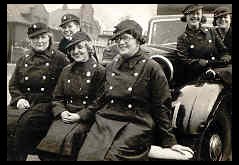
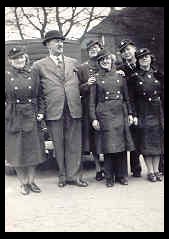
Musgrave, who worked at Fairey Aviation. See "Aviation" page. I have always had an interest in The Second World War. I think this was sparked by the many War Films that were being made in the 1950's.plus the memories of my parents & neighbours. The war had only been over 4 years when I was born in 1949,so it was still very vivid in the minds of those who had lived through it. Unlike previous wars, The Second World War affected not only the people in the fighting services, but also the civilian population. This civilian War was known as The Home Front, and this page is dedicated mainly to those who fought this important, but generally forgotten part of our history. I have to admit that I have little knowledge of Levenshulme's role in The Home Front. As a child I remember playing in neighbours Air Raid shelters, and seeing the fading signs of wartime on the corners of streets & on lamp posts. Remember the EWS sign on the corner of Station Road. EWS ( Emergency Water Supply) painted in large yellow letters, and an arrow pointing East, probably to the Brickie Pond! Also Black & White stripes on lamp posts & kerbs, to assist people out walking and driving during the "blackout". Alma Park Depot. Section "C" ARP The following series of photographs were taken at Alma Park School during the Second World War. I do not know the year, as there is no reference on the photos. However, from what my mother told me it would probably be 1942 or later. It appears to be winter or autumn, as there are no leaves on the trees! My mother Doris Wilson & my aunt Mary Nixon appear in some of the photos. There are names on the back of a couple of the photos. Section "C" was a medical section. The ambulance seen in the photos is of "utility" design, and may have been a conversion from a civilian vehicle. My mother & aunt manned one of these ambulances. My mother was the attendant & my aunt was the driver. I remember my Mum telling me about picking up wounded German soldiers at a Manchester station, and taking them to a hospital/camp near Mellands playing fields. The soldiers may have been prisoners of war captured in North Africa or Italy.
A very interesting photo taken at the Alma Park ARP depot during wartime. Exactly what this converted single decker bus was used for I do not know. Possibly some kind of rescue vehicle! Ladders inside, pole on the roof and a Union Jack in the front window! Note the white painted fenders etc. Also more trucks in the sheds. The houses in the background are on Alma Road. (via Manchester Libraries)
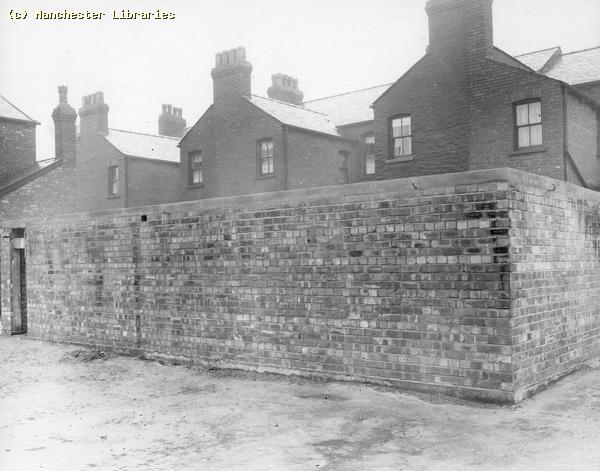
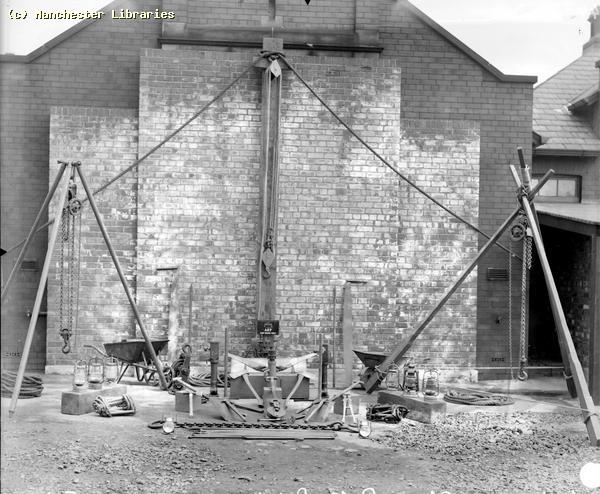
Another interesting photo taken at Alma Park Depot. This shows a " Blast Wall" being constructed. This would have been to protect an entrance way from blast damage in the event of a bomb exploding in close proximity. ( via Manchester Libraries)
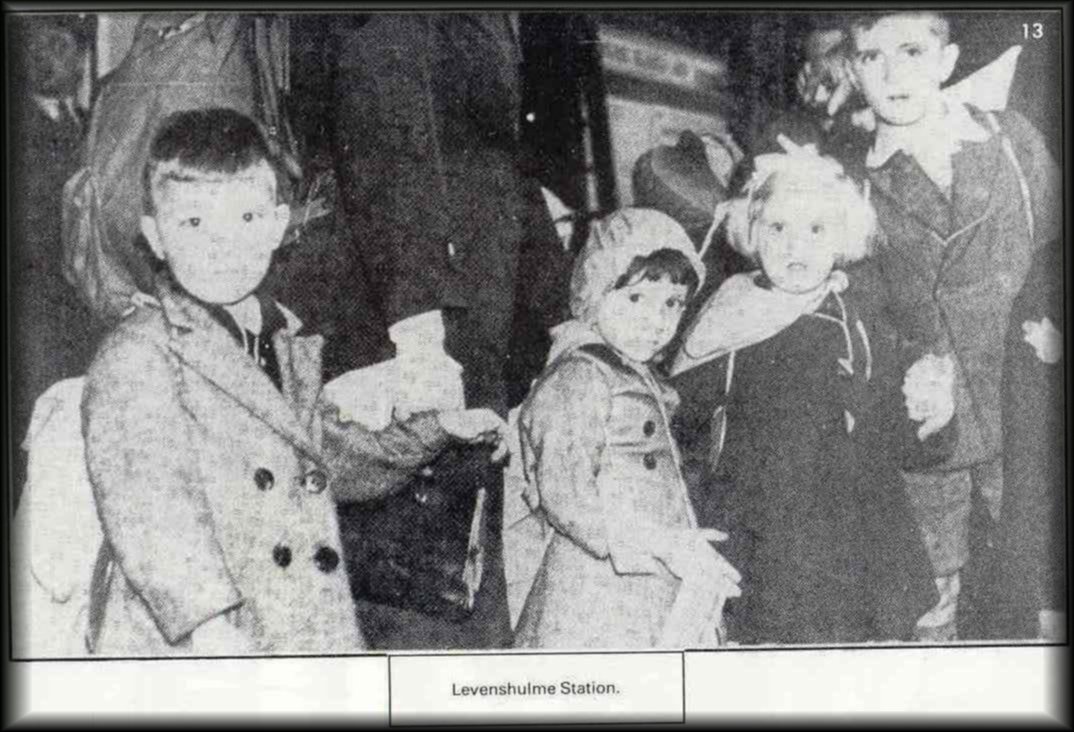
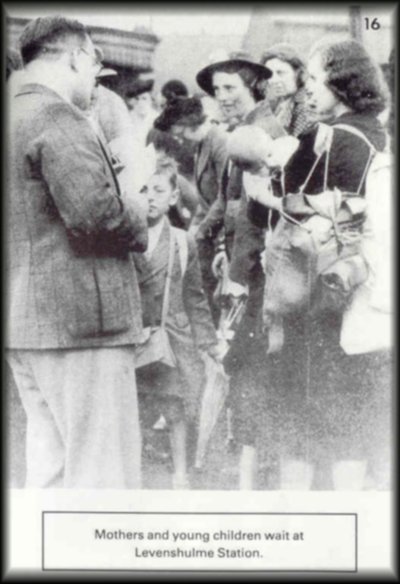
Evacuation. Levenshulme stations 1939
The photographs above are from a publication called "Manchester at War". This was printed, by The Manchester Evening News, in the mid 1980's and is a very well researched history of Manchester in wartime. There was supposed to be a second volume. Did it ever get published? I found my copy in an Antique store in Edmonton, Canada!! These are the only published pictures I have ever found of Levenshulme in wartime. They were probably taken in 1939,and may both have been taken at Levenshulme South Station. Note: The second photograph shows houses above the station The houses could be in Samuel Street or Kersh Avenue, off Marley Road.
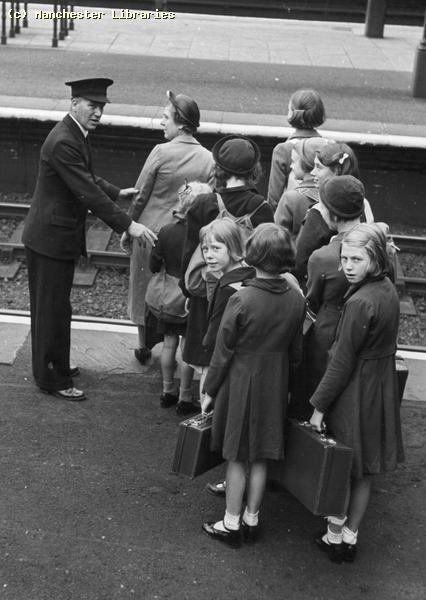
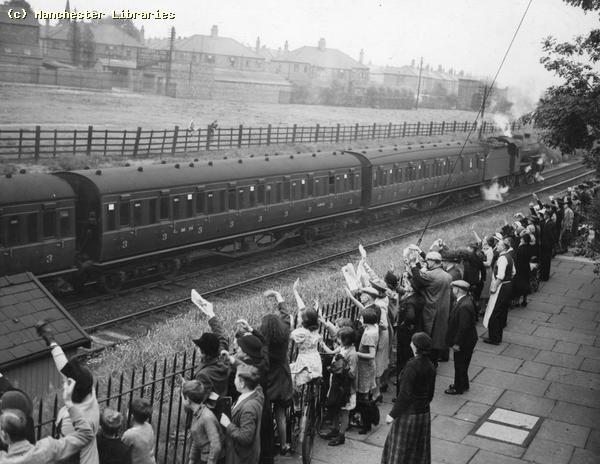
Not Levenshulme, but these photos show children being evacuated in late 1939. Does anyone recognize the station? It is in the Manchester area! ( Manchester Libraries) Update:- I have been advised that this station is Chorlton, on the Fallowfield Loop Line. Bombs & Doodlebugs over Levenshulme. Wartime memories of Tom Pollitt "Did I collect shrapnel? We all did! I don't know how many of my pants pockets got shredded by the jagged bits of metal, my mother had to repair them every couple of weeks. There was a lively trade going swapping bits of shrapnel, any pieces with lettering on them were highly prized. I recall getting up early one morning after a particularly heavy air-raid and finding some pieces with letters on them, and one with part of a swastika on it. I found it near a small crater in the car park of the Bluebell pub, which backs on to Chapel Street Park, on Barlow Road. On my last visit in 2000, I was driving down Barlow Road, when I remembered that raid. I said to my wife " I just want to check something out", and I drove into the car park of the pub where the bomb had exploded, and the bricks and wall tiles of the pub still bore the pock marks caused by the shrapnel from that bomb! I couldn't believe after all these years they were still there. I went over & touched the scarred bricks, and it seemed for a moment that nearly sixty years had been washed away and that morning so long ago was just yesterday! On another occasion my Dad was home on leave. He was a sergeant major in the Royal Artillery, Heavy Anti-Aircraft, based at Dover. The siren went, and we all went in the backyard Anderson shelter. We heard what I thought was a low flying bomber, but my Dad new only too well what it was! He took me to the door and showed me this long flame speeding overhead. It was my first sighting of a V1 flying bomb or "Doodlebug" as they were called. It roared over with a sound like half a dozen Harleys. My Dad said "don't worry about the noise it makes, it's when the engine stopsthat you should worry!" Because when they ran out of fuel they crashed & exploded. My Dad had seen plenty of them, and shot them down over Dover, as they targeted London. We played in the UCP public air raid shelters after the war. They made a great submarine, with the emergency exit an ideal conning tower. The Ve Day party in George Street is another event etched in my memory. I'd never seen so much food! I don't kno where it all came from, food rationing was still on, but tables placed end to end down the middle of the street were stacked with big pots of stew, sandwiches( butties!!), and cakes. The Mams certainly worked a miracle to rival the loaves & fishes! " Tom Pollitt was born in 1935, and lived in Longsight & Levenshulme before emigrating to Australia with his parents in 1950. Tom lived at 15 George Street, now Greenaway Ave, off Highfield Road. He went to Chapel Street School. During the war he was evacuated to Glossop for a few weeks. He remembers a barrage balloon unit in the school playground, and anti-glider poles being erected on Greenbank Playing Fields & also on Mellands. He also remembers standing outside The Grand cinema, and asking adults to take him in to see "A" rated films!! Thanks for the memories Tom. "Over Here" The Yanks In Levenshulme. I have little detail on the "American Invasion" of Levenshulme, but I have been informed that prior to D-Day many American soldiers (G.I's) were billeted along Broom Lane. Also there were some near the Lido Cinema on Kingsway, Burnage. Memories & Photos would be appreciated.
Not Levenshulme, this photograph was taken outside Fallowfield Station, but note the two parked jeeps. Proof of Yanks in South Manchester!! ( Photo Fallowfield Loop Line)
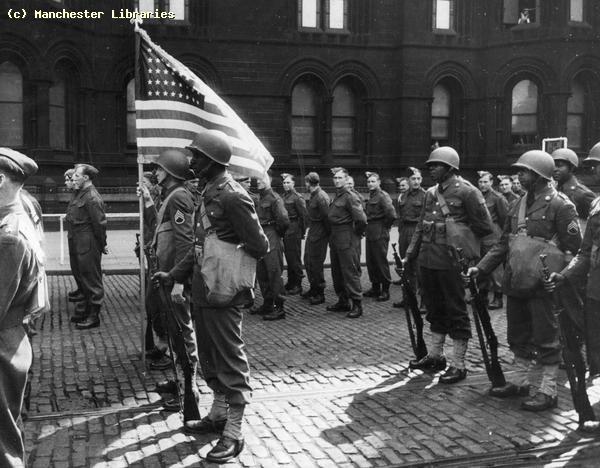
Again not Levenshulme, but at least proof of "Yanks" in the Manchester area. This looks like a parade outside the Manchester Town Hall in Albert Square. Most of the G I's are African American, excepting the NCO, who may be holding the Stars and Stripes. I would be interested to find more photos of " Yanks" in Manchester or area! (Manchester Libraries) I have recently received a couple of communications from Doreen Lococo (nee. Needham) who was a pupil at Levenshulme High School For Girls during the war years, and was a classmate of Dorothy Bromiley (see the Cinema and TV page). Doreen had a particular memory of seeing American soldiers in the vicinity of the school. She writes:- "There is one thing I remember of that time. American soldiers must have had a barracks or something nearby because they were often marching along Crossley Road in front of the school, and as the railings around the school had already been taken away to go towards making munitions, it seemed like an open invitation for the soldiers to lie on the grass at the bottom of the field and watch us during our sports lessons-Hockey and Lacrosse. It's kind of sad to think about it now as it's possible that many of those soldiers were killed on D-Day or thereafter. I wonder if many of them still living remember Levenshulme!" Anti-Aircraft, Searchlight Batteries and Barrage Balloon Sites in Levenshulme. There were several anti-aircraft batteries & searchlight batteries located in the Levenshulme Area. Exact locations are vague, but I have been informed of the approximate locations of some of these. Anti Aircraft Guns were located on Mellands' Playing Fields & possibly also on Manor Road. Also guns were located in the Fairey Aviation factory ( See "Aviation" page) and possibly on Cringle Fields & Errwood Park. A searchlight battery was located on the East Levenshulme Cricket Ground, Elsa Road area, but there were probably others, as searchlights worked in conjunction with the guns. I have also had information that multiple rocket batteries were also located in Errwood Park. Some of the guns may have been operated by the 71st Manchester Heavy Ack Ack ( Home Guard) Battery. An account of this battery can be found on the BBC's WW2 Peoples War web site.
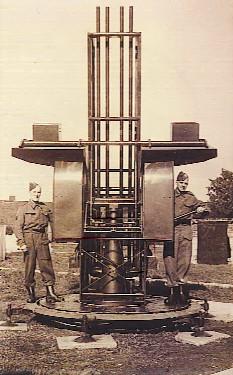
The above photo shows a multiple rocket launcher. These may have been located in Errwood Park and other Anti-Aircraft sites in the South Manchester area!
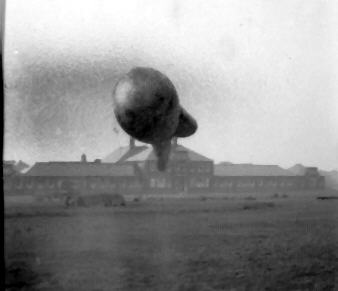
A Barrage Balloon on the Playing Fields at Burnage Grammar School, Burnage Lane. The Grammar School did receive bomb damage in the Blitz of 1940/41.
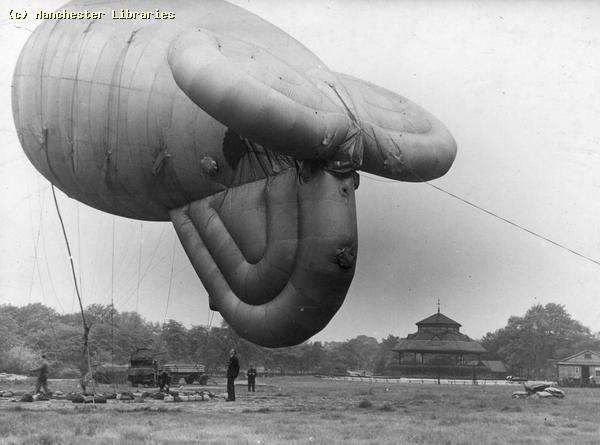
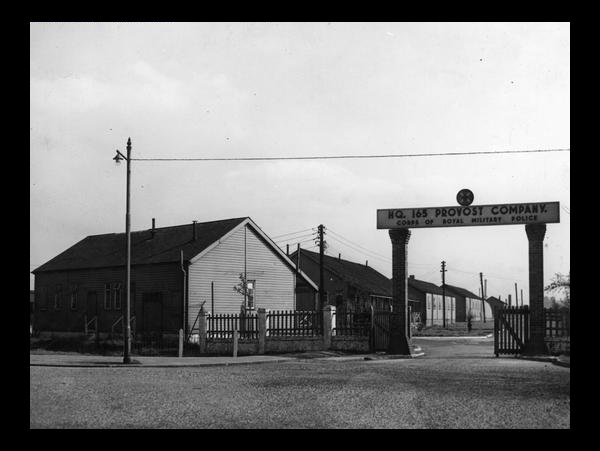
This photo of a Barrage Balloon was taken somewhere in Manchester, but not Levenshulme. The building in the background may be a clue to the exact location! Note the truck in the background carrying the gas cylinders to inflate the balloon. There were probably several balloon sites in Levenshulme, probably in parks or on waste ground. Update:- This location has been identified as Birchfields Park, Rusholme by Bruce Anderson, January 2011. (Manchester Libraries) Mellands Playing Field Mellands Playing Fields played a varied role in World War Two. Besides being an anti-aircraft gun location, it was also used as a temporary POW camp for Italian prisoners & later was a Military Police establishment. Photos of these would be most interesting to see.
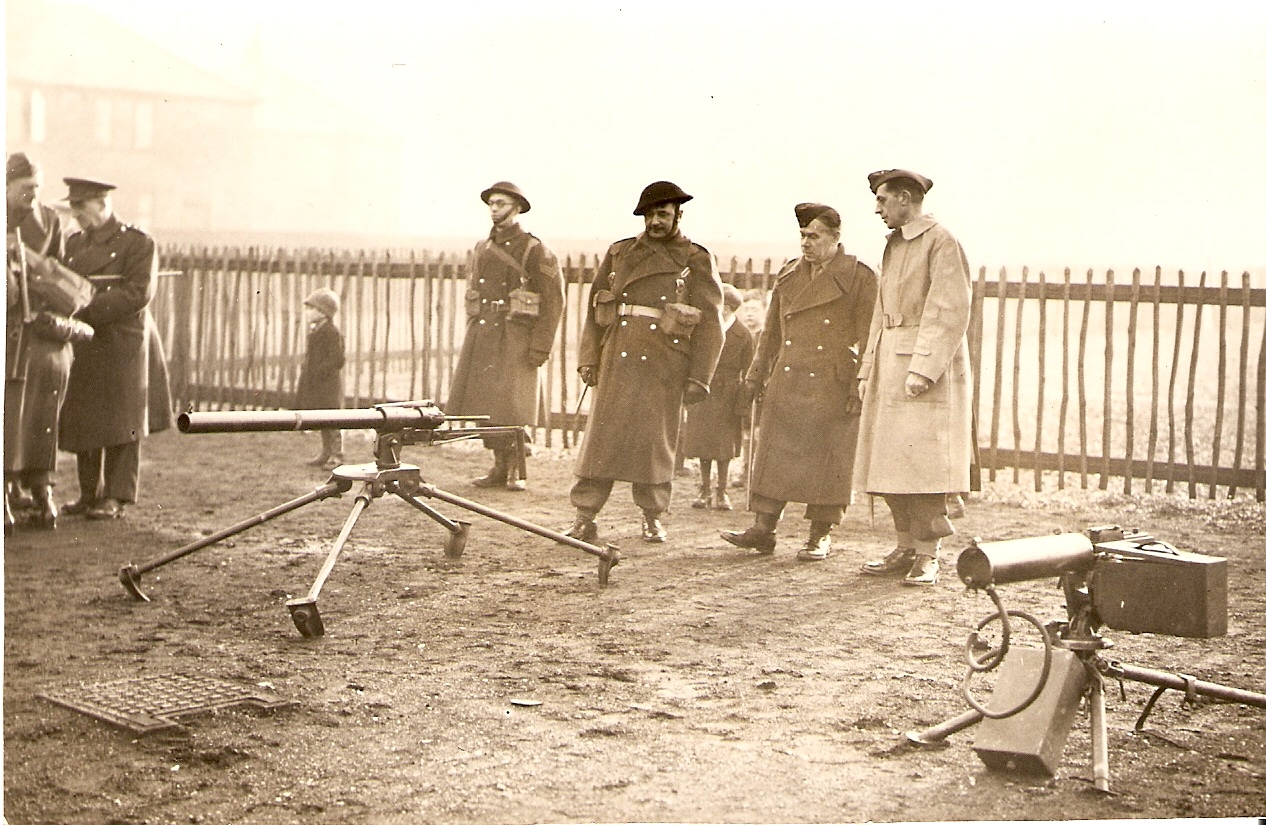
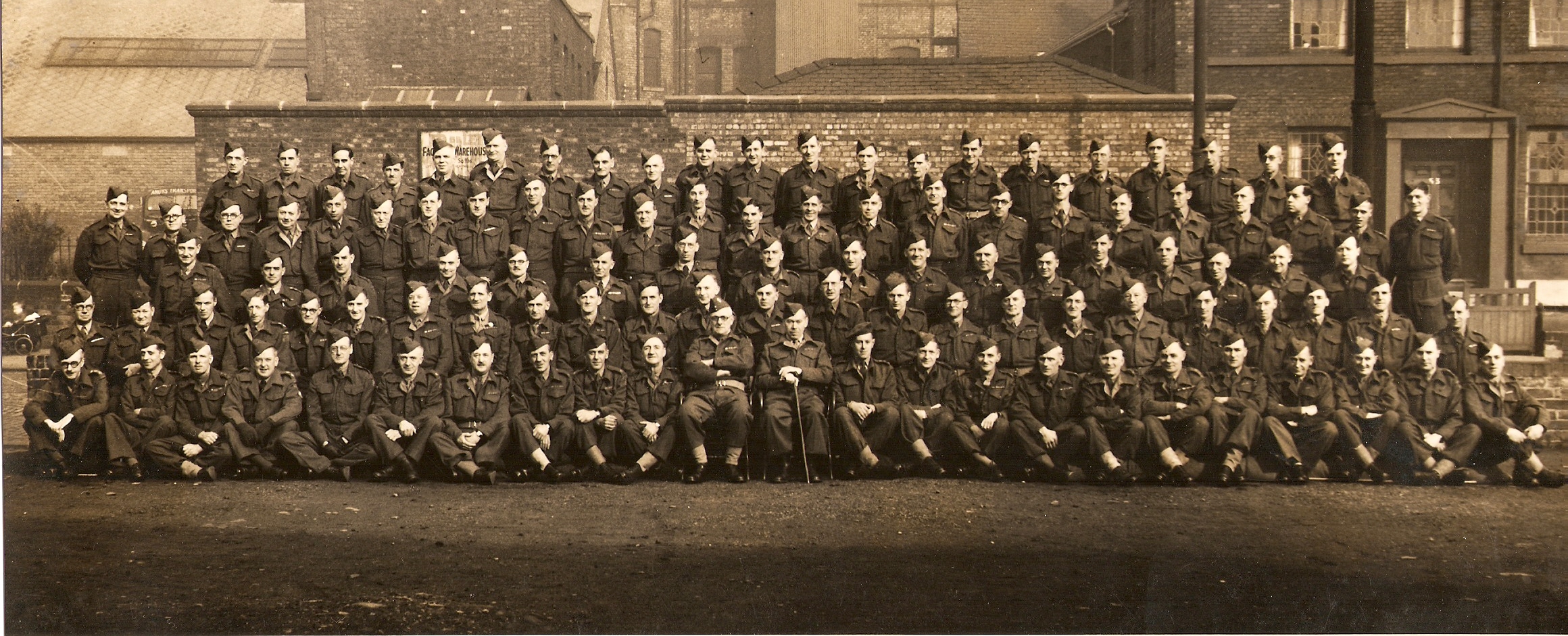
This is the gate of the Military Police Camp on Mellands Playing Fields. Previously used as a POW camp. The Home Guard ( Dads Army) in Levenshulme. I recently received some information off Brian Wood on the Home Guard Units in the Levenshulme & Gorton Area. Brian states that the 48th Battalion Manchester Home Guard used the facilities on Mellands Playing Fields, and that Levenshulme Home Guard could have been part of "D" Company which also covered Gorton and Openshaw. The photos below were supplied by Brian.
Armament inspection on Mellands Playing Fields. ( via Brian Wood)
On Parade, Mellands Playing Fields. Note some of the soldiers are carrying Sten Guns! ( Via Brian Wood)
This is a group photo of the Home Guard Unit of 48th Battalion. Any idea as to where this photo was taken? The truck in the background reads "Arnuts Transport" and there is a sign on the wall that reads "? Factory Warehouse".
Air Raid Shelters
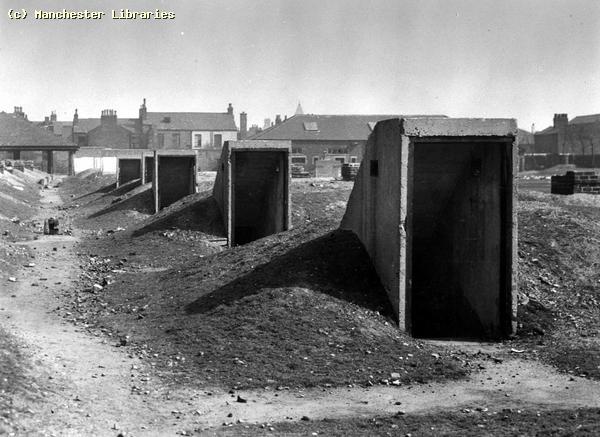
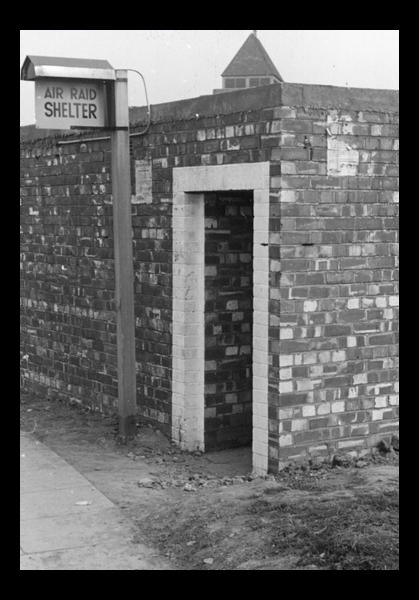
This is not Levenshulme, but is typical of the type of structure used for communal air raid shelters in the area. I believe that I remember one near Robinsons Bakery, off Chapel Street. I have also been advised that there was one located near the UCP Tripe Works. Does anyone have any knowledge of other large air raid shelters in Levenshulme, or if any still exist?
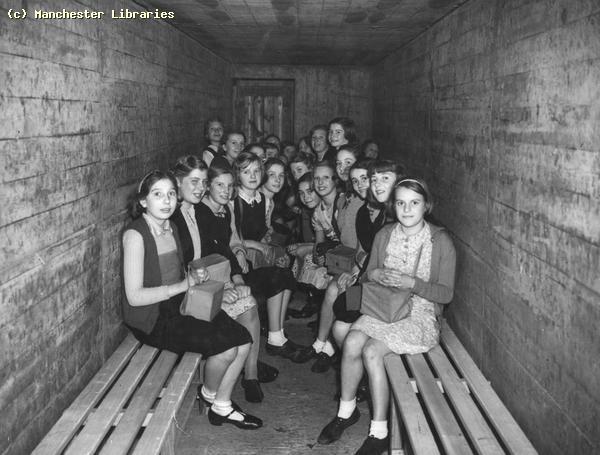
This view shows the interior of a type of communal Air Raid Shelter. It looks very cramped. Possibly taken at a local girls school. Note all the girls are holding gas mask containers. ( Manchester Libraries)
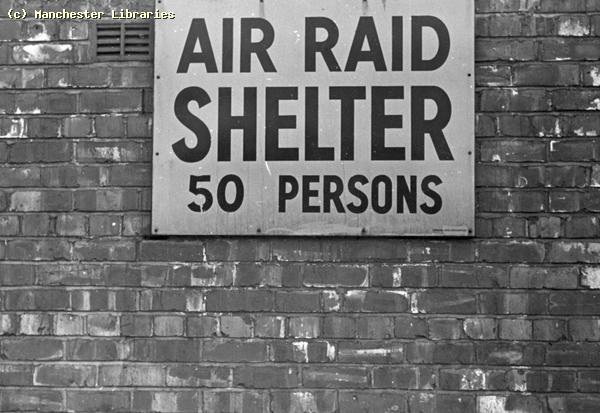
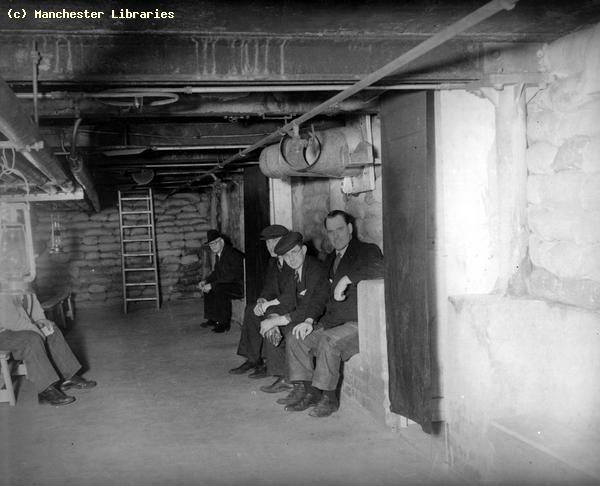
Two more photos showing Air Raid shelters. The first shows a sign posting the limit of persons allowed in the shelter. The second shows workers in a shelter, which maybe underneath Birchfields Tram Depot. ( Manchester Libraries)
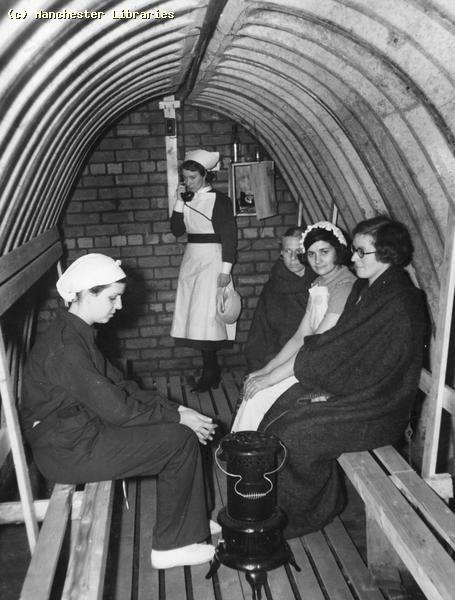
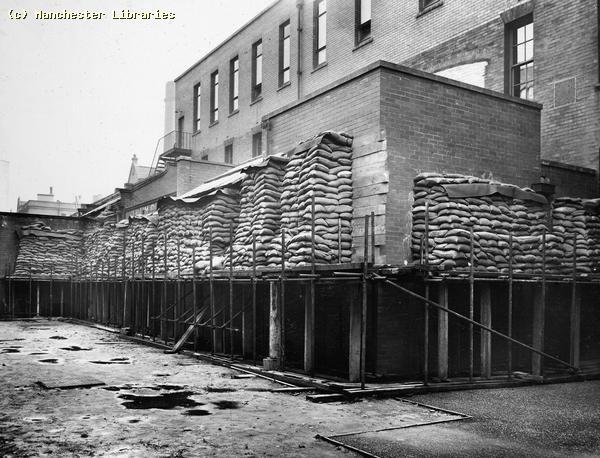
These two photos show 1) patients and nurses in an Anderson type shelter, 2) A hospital, possibly St.Marys, Oxford Road heavily sandbagged against blast damage. ( Manchester Libraries)
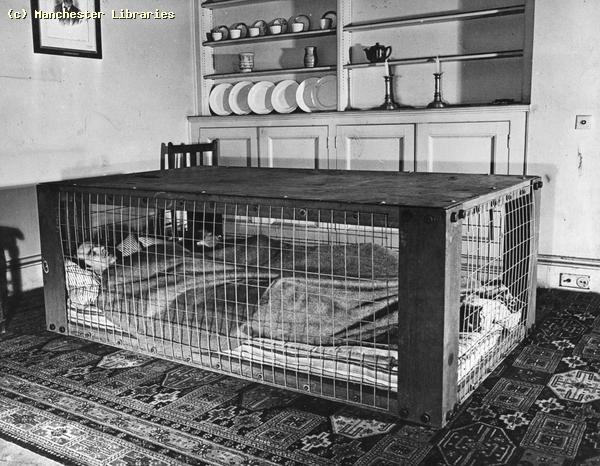
A Steel inside air raid shelter with occupants! I do not know how widespread the use of this device was. Would it withstand a house collapsing on top of it? It could also double as a dining table ( Manchester Libraries)
Wartime information on how to assemble the Morrison Table Shelter.
The above two photos show the entrances to underground air raid shelters in the Manchester area. Neither photo has a caption saying where it is! Does anyone recognize the locations? ( Manchester Libraries) Update:- Correspondent Peter Shelton Thinks that the second photo shows shelters in Jackson Street, Hulme. He says that new flats were built on this site after the war.
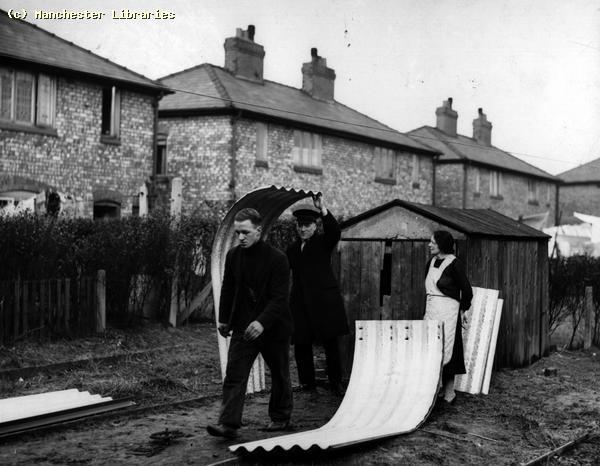
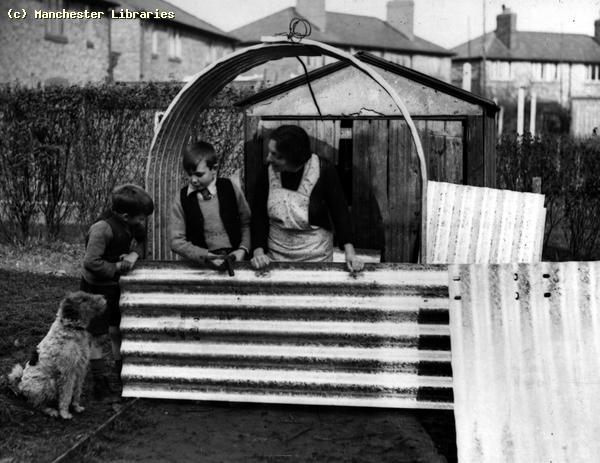
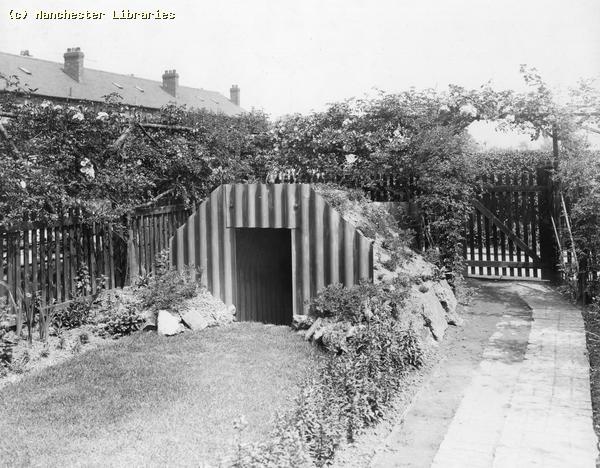
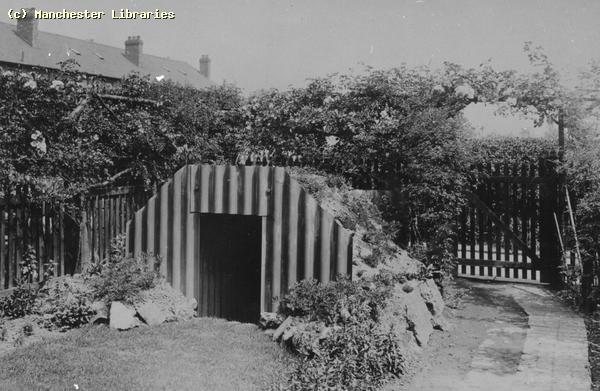
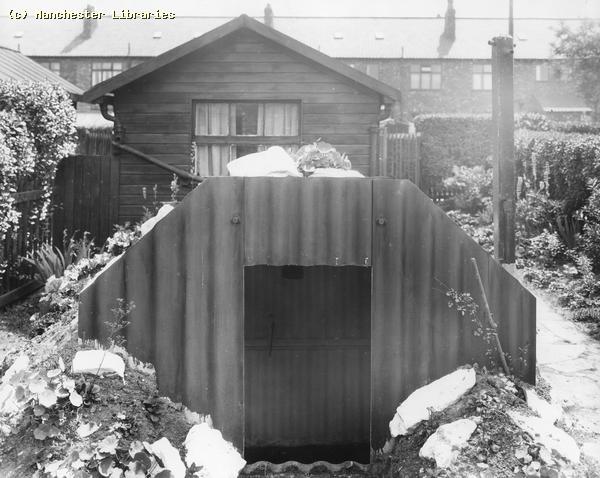
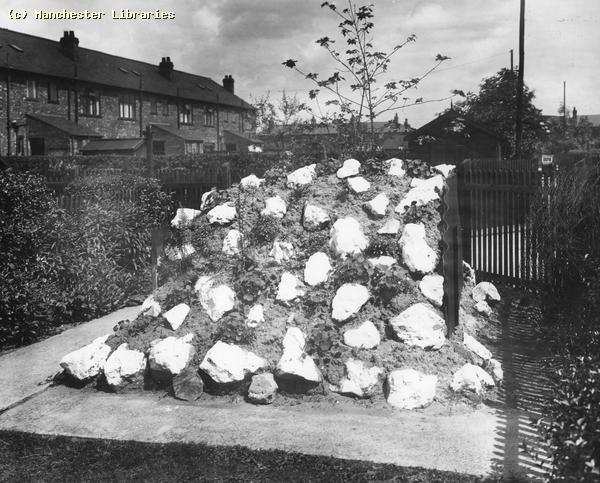
I have never seen this type of air raid shelter before! It appears to be made of reinforced concrete. It would not seem to provide much protection!! ( Manchester Libraries) The Anderson Shelter The Anderson Shelter was a prefabricated, corrugated metal air raid shelter provided to many homeowners with back gardens. The shelter consisted of two "J" shaped pieces, which formed the sides and roof, together with a front and back piece one of which had a doorway. The Anderson shelters were supposed to be set into the ground, and then covered with earth to provide bomb blast protection. After the war many were used as garden sheds. The Anderson had a habit of flooding during heavy rain showers, making for a very uncomfortable place to be during air raids! The next series of photos show how the Anderson was constructed and used.
The above series of photos show how the Anderson Shelter arrived, and how it was constructed and covered with earth. In this particular example the earth covering has been turned into a rockery for added protection. ( all photos Manchester Libraries)
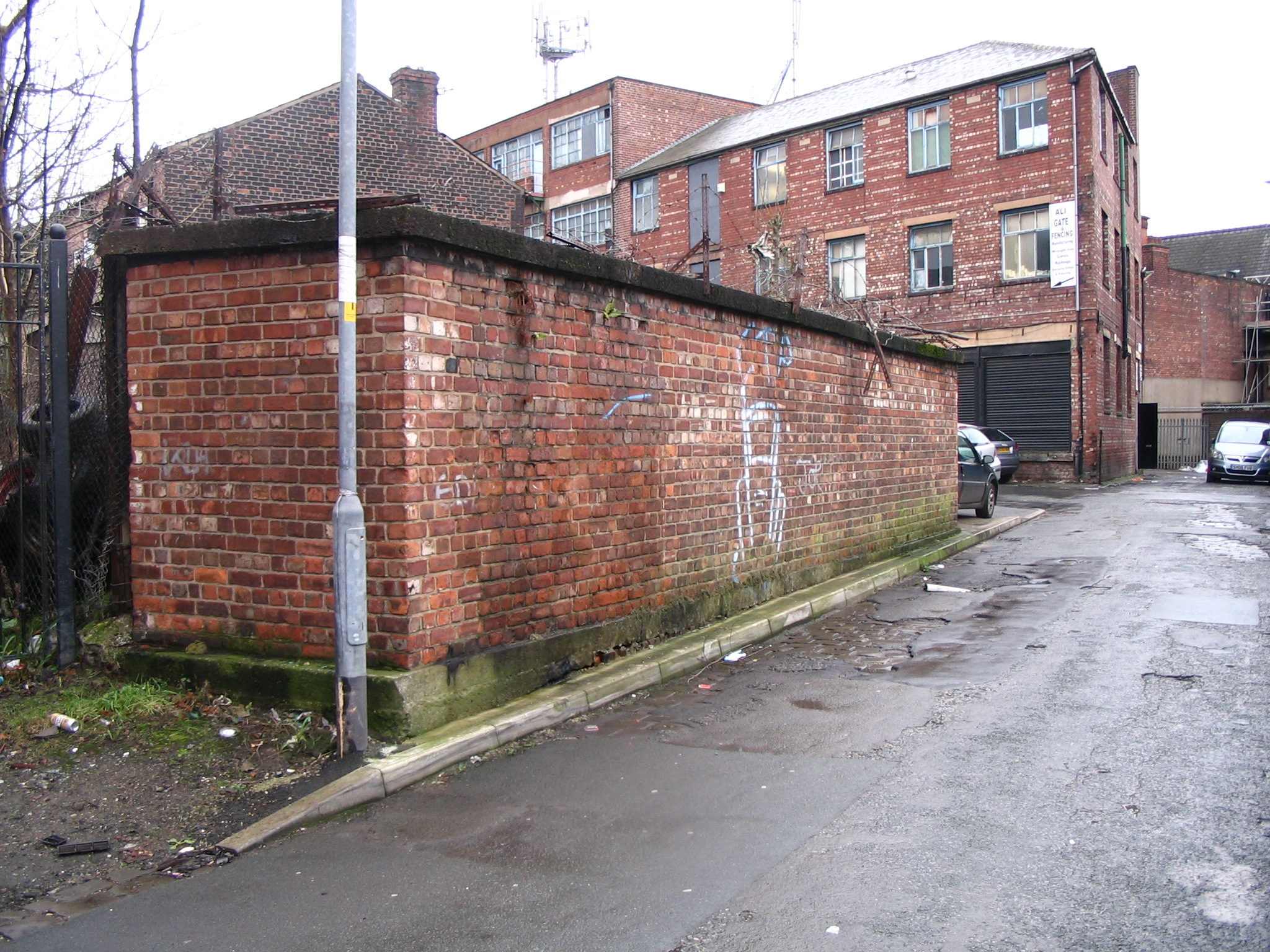
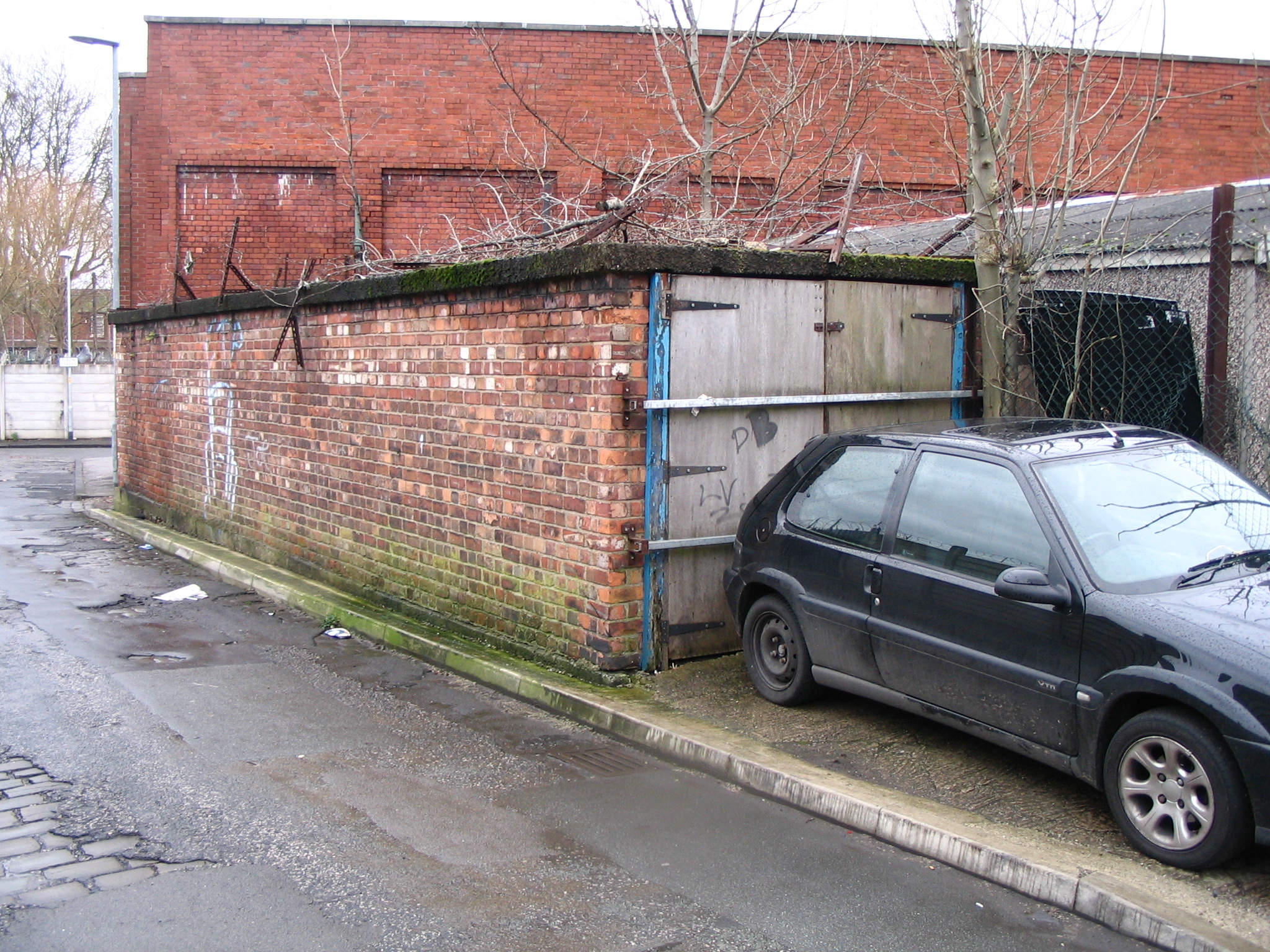
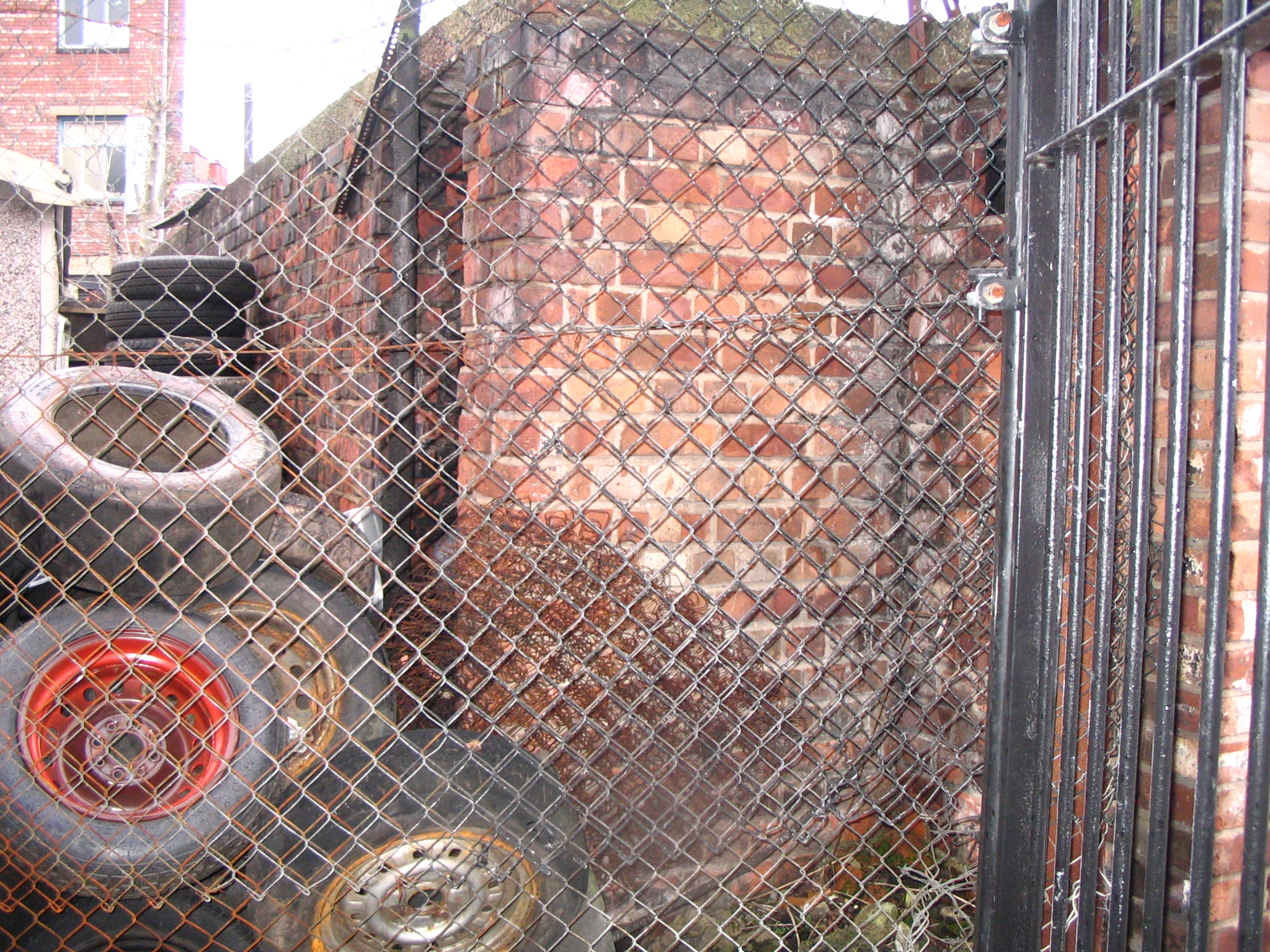
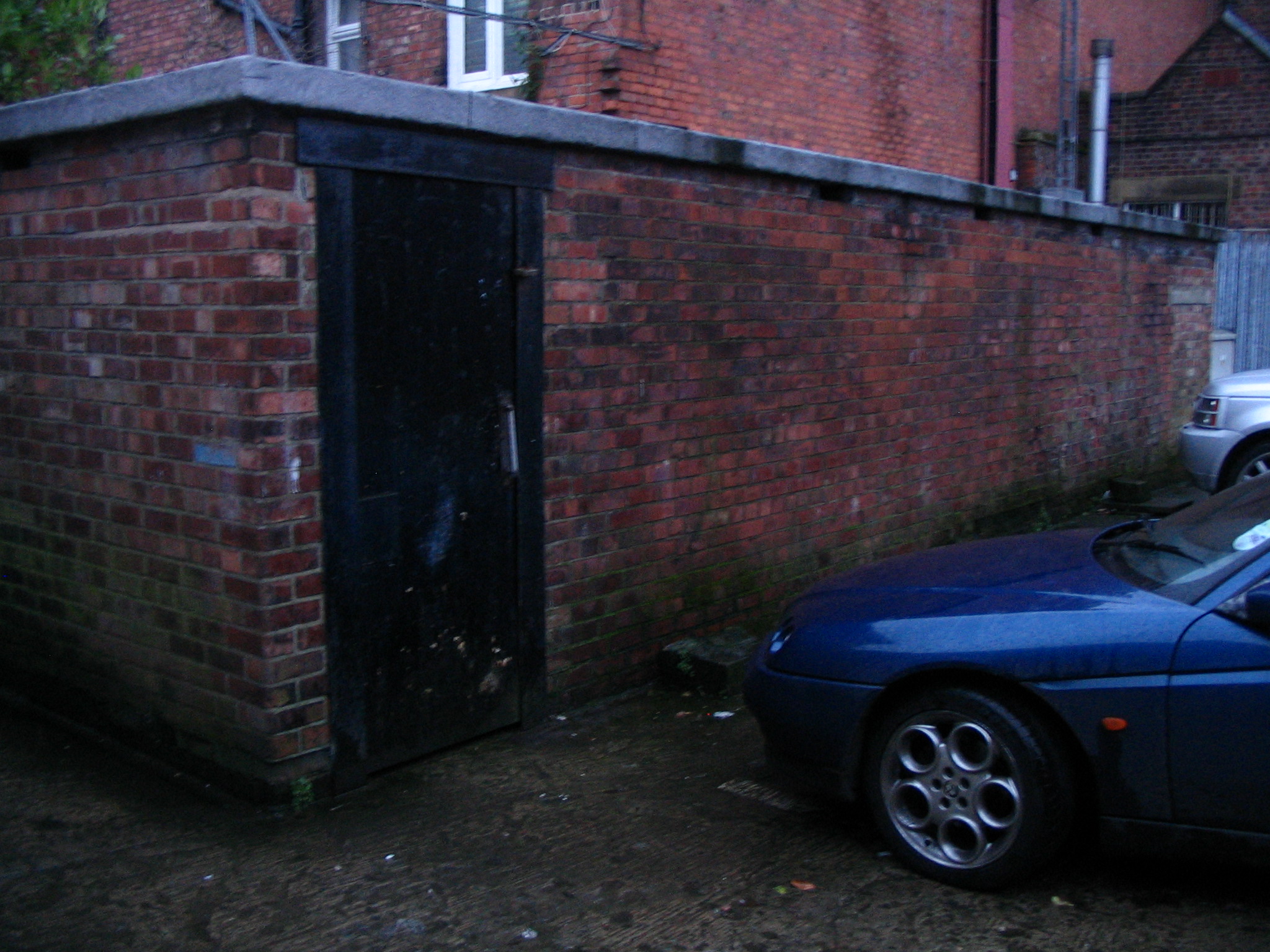
Air Raid Shelters in Levenshulme 2007 On my recent trip to Levenshulme in December 2007, I tried to find some evidence of wartime Levenshulme. To my surprise I found two large communal air raid shelters still in existence. The one that I had previously mentioned near the old Robinsons Bakery is still there. Also one that I had no knowledge of at all. This second one is in the yard of the old Levenshulme Town Hall. They are both in remarkably good condition. My feeling are that these are fairly unique structures, and should be preserved as a memorial to all those civilians who endured the rigors and hardships of the " Home Front" during the Second World War.
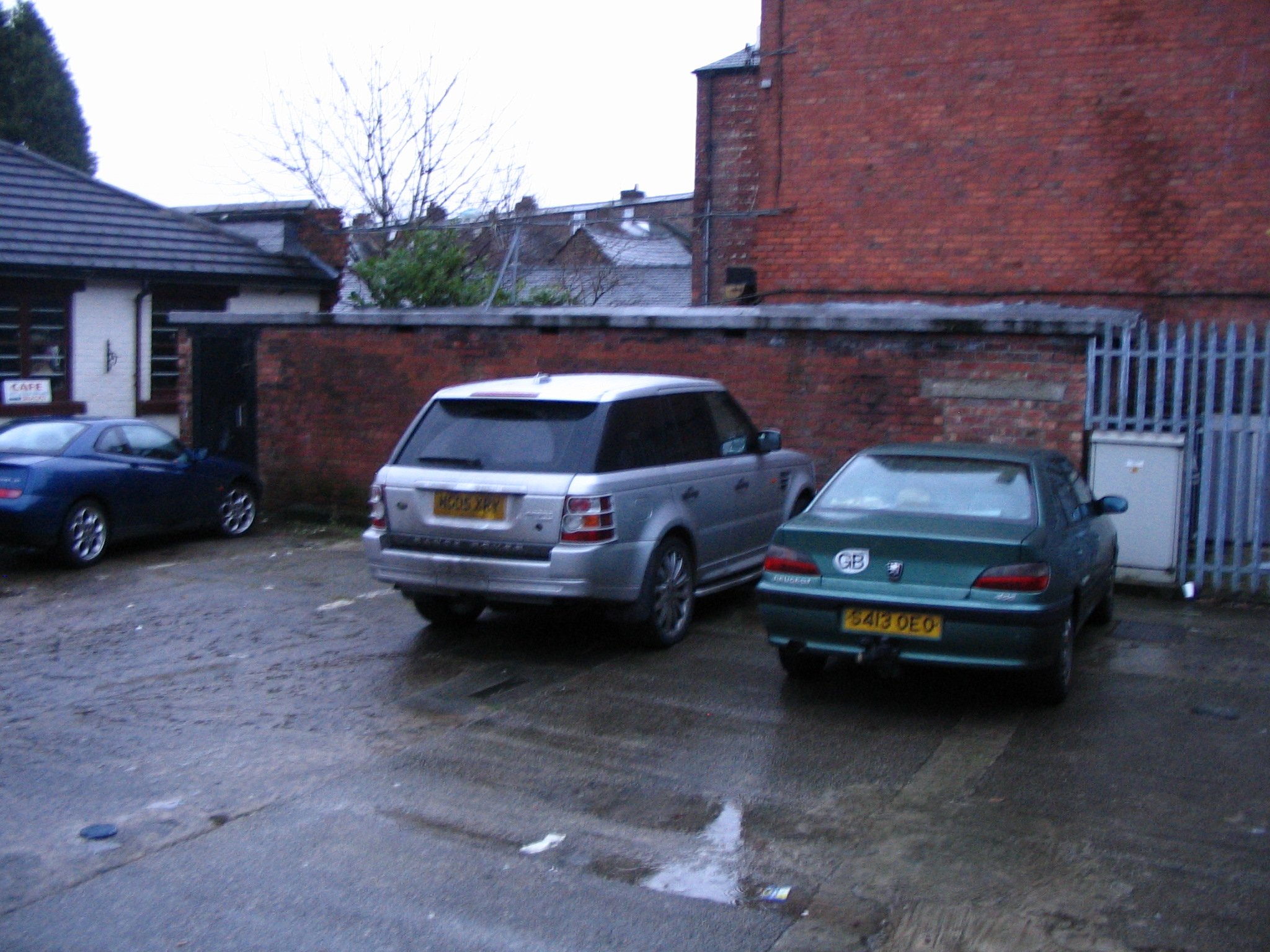
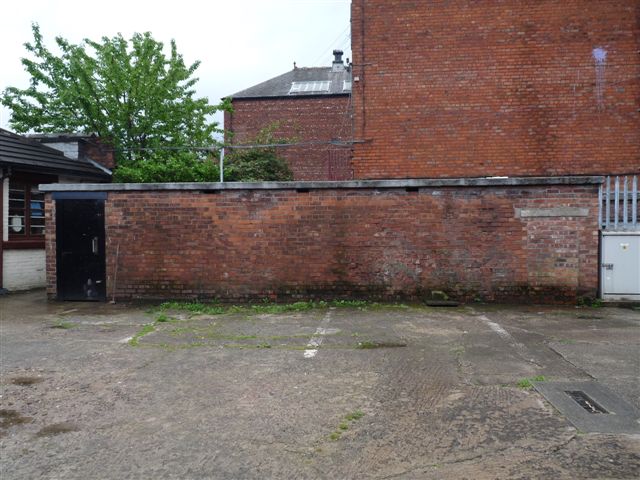
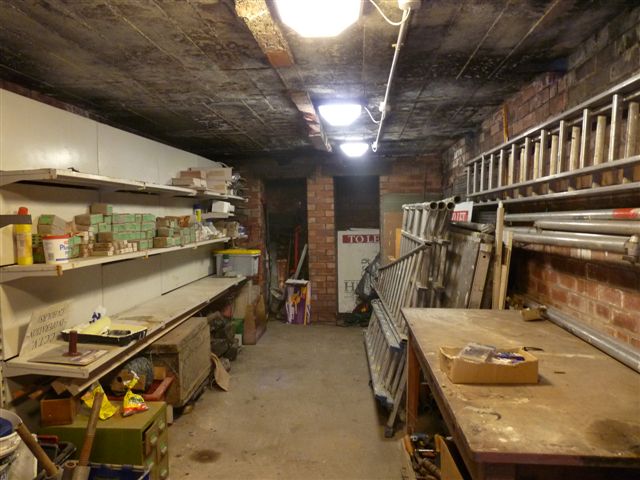
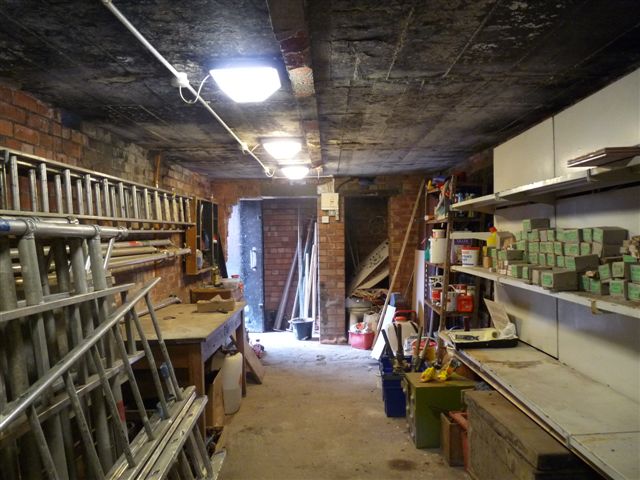
The Communal Air Raid Shelter off Chapel Street, near to the old Robinsons Bakery. The road that it is sited on does not ever appear to have had a name. The shelter is in good condition , now in use as a garage for a car repair business. The third photo shows the entrance. This size of shelter would have held about 50 people. It is what is known as a surface shelter. Of brick and concrete construction it provided refuge from blast damage, but would not have stood up to a direct hit!
The second Communal Air Raid Shelter behind the old Levenshulme Town Hall, now the Antiques Village. This is only about 100 yards away from where I lived on Crayfield Road, yet I only found it in 2007!! This shelter is also a surface shelter, but it may have been partially set into the ground. Notice the bricked up entrance on the right and the newer door on the left. Again a 50 person shelter. This was probably built for the use of the staff at the council offices and those in the police station next door. Does anyone have any memories of these shelters, or similar ones in other parts of Levenshulme?
A clearer view of the Town Hall shelter in August 2010. Now in use as a workshop.
Two interior views of the Town Hall shelter. ( all via Mike Berrell)
Wartime photo of a large communal air raid shelter. ( Manchester Libraries)
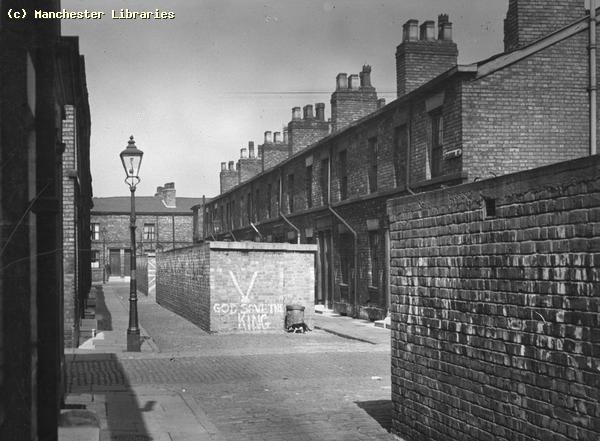
Air raid shelters built in the middle of the street! Note the "V" for Victory sign and "God Save The King". Any idea of the location? ( Manchester Libraries)
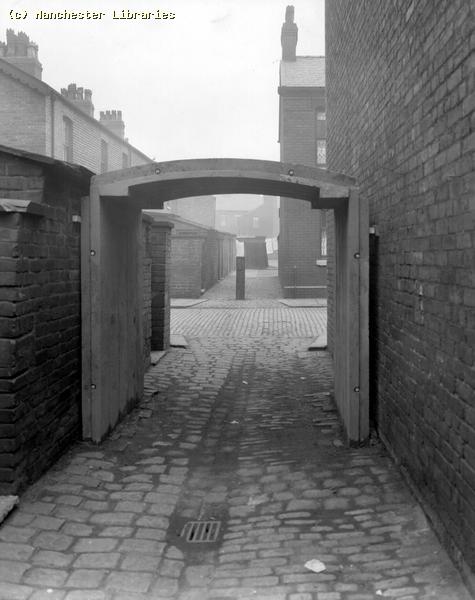
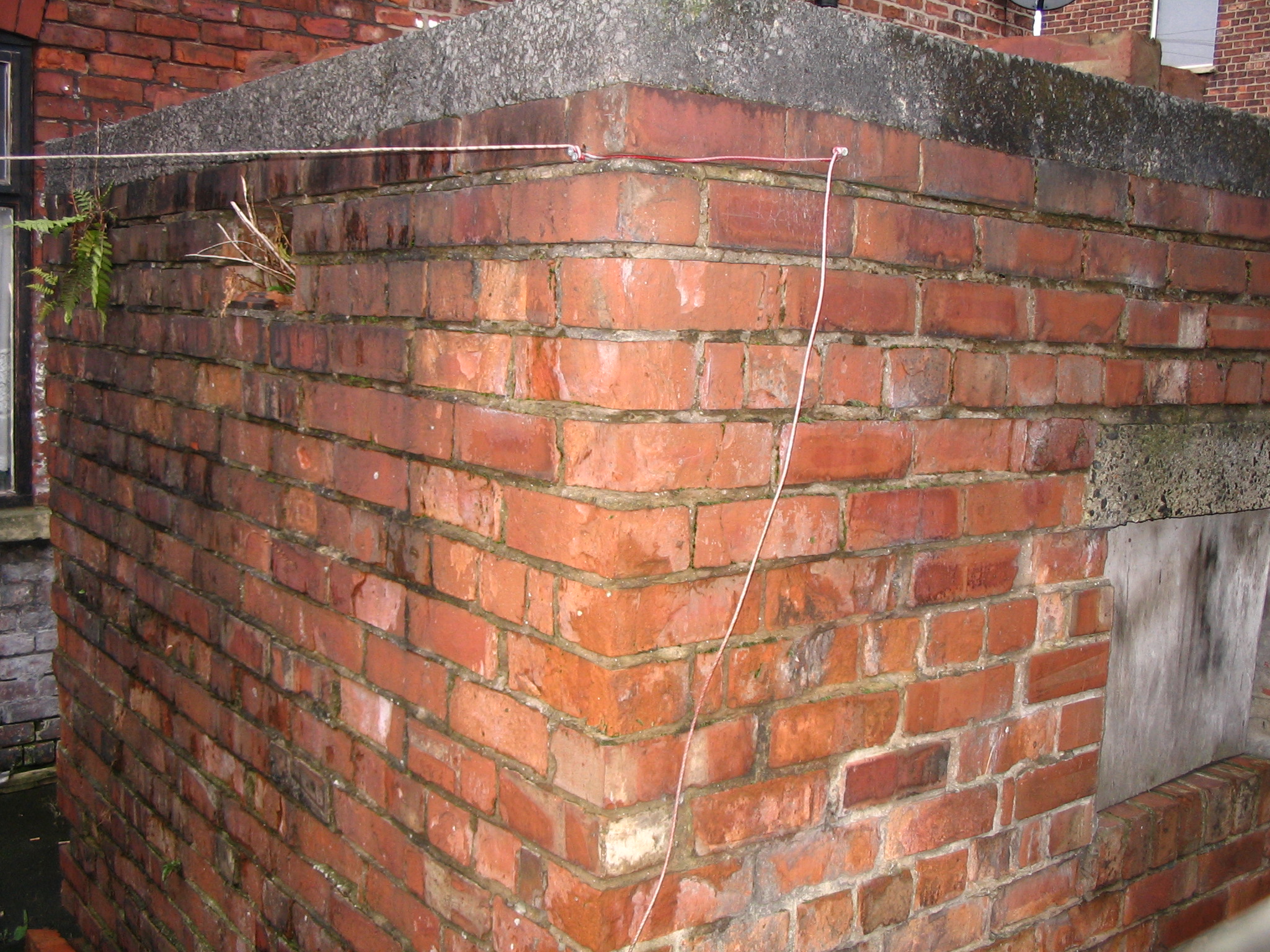
This is a typical "back yard" air raid shelter, situated in a yard behind Cardus Street. Still standing in 2007. These shelters were built in back yards and were intended for the use of several families in a street or terrace. After the war most were used as storage shelters or sheds. Some were used as "dens" by the local kids. Eventually most were torn down, with some difficulty. Imagine breaking that reinforced concrete roof without a pneumatic drill!! Another Levenshulme Air Raid Shelter
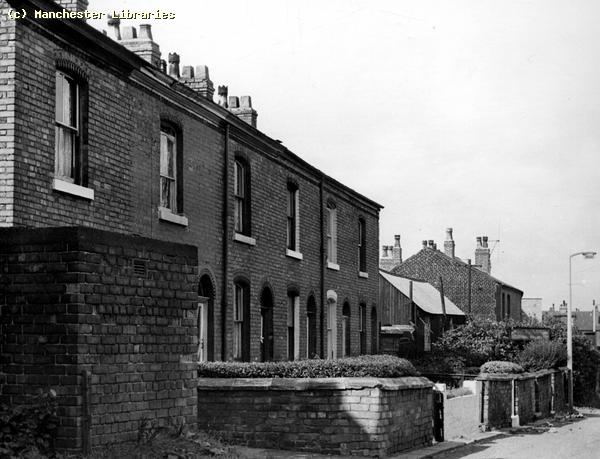
This photo shows the end of another air raid shelter on Elbow Street in 1965. It probably provided shelter for the residents of the houses in the background. Does the shelter still exist? The houses still exist, but now have modern frontages. ( Manchester Libraries)
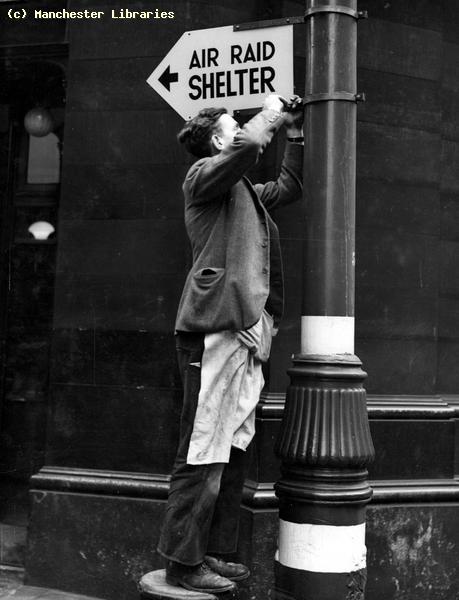
A common sight during wartime, signs directing people to the nearest air raid shelter. Note also the white painted lines on the signpost to aid drivers during the hours of darkness when the total blackout was enforced. ( Manchester Libraries) Emergency Water Supplies
This photo shows the very feint lettering of an Emergency Water Supply sign situated on the corner of Elbow Street and Stockport Road. These EWS signs were painted on walls to indicate to the Fire Services where the closest water supply was situated. There were at one time several reservoirs situated off Elbow Street. They were used originally for the carpet mills in the area. The land has since been filled in and St Marys church and Manse now stand on those grounds.
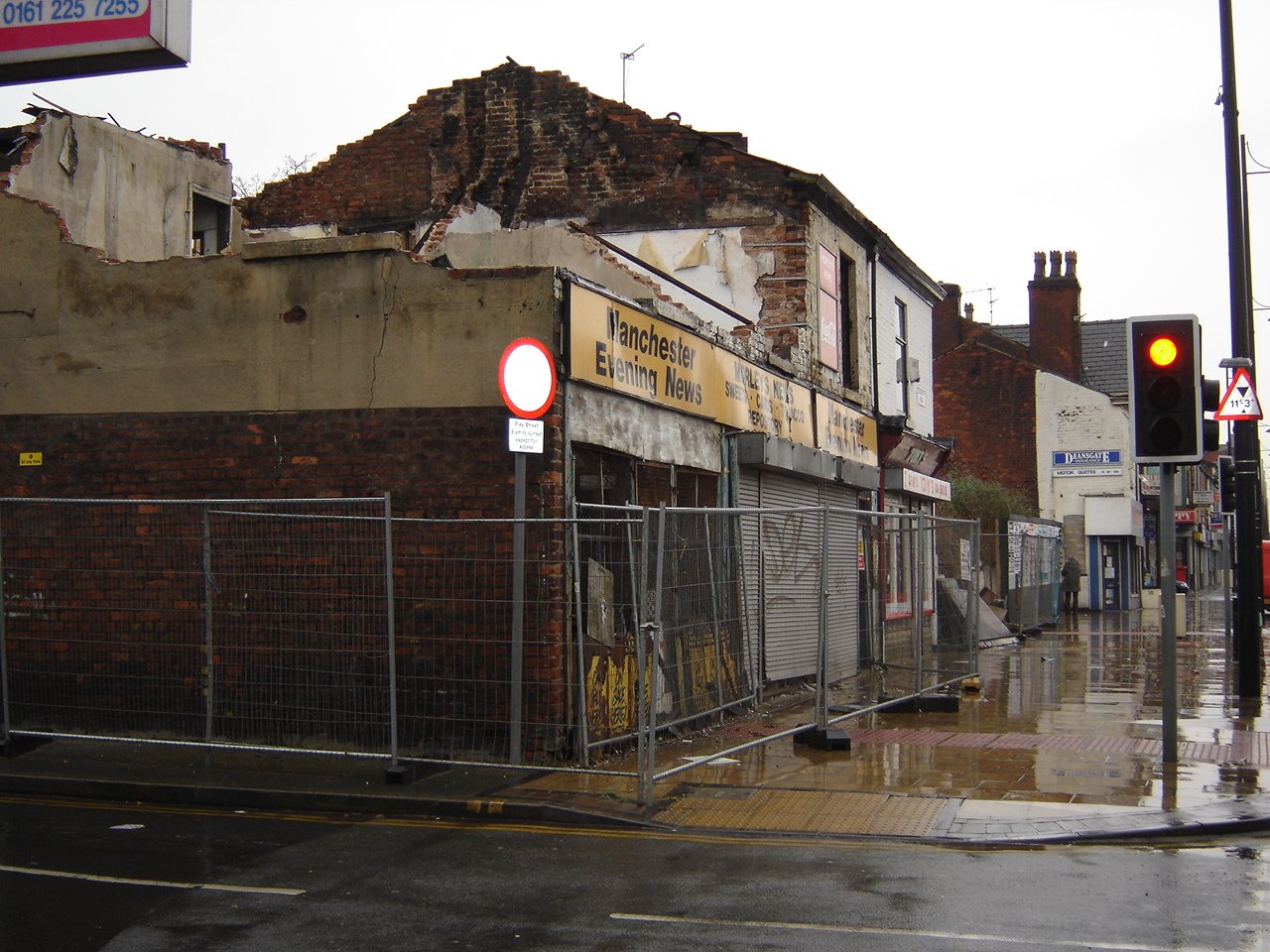
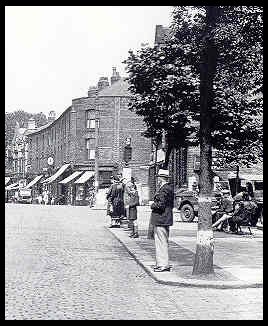
This is the corner where the sign is situated. Looking somewhat like a scene from the Blitz. It is still like this as of December 2007. ( Both photos via Andrew Barber) Does anyone remember other EWS signs in the Levenshulme area? I remember one on the corner of Crayfield Road/Station Road and Stockport Road. Is there any other evidence of Levenshulmes wartime past still existing in 2007?
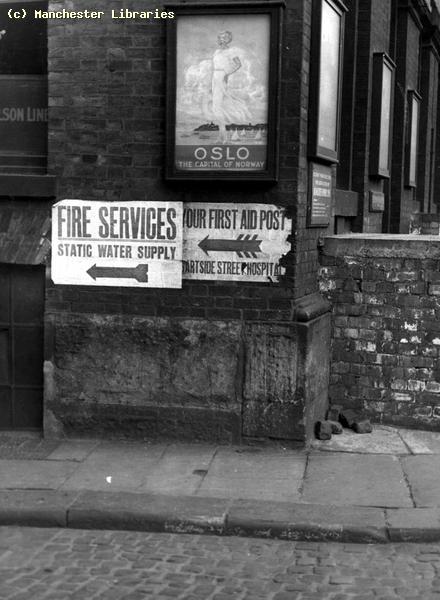
Not Levenshulme, but typical of early wartime emergency signage. Somewhere near Gartside Street, off Deansgate. (Manchester Libraries) Rationing in Wartime.
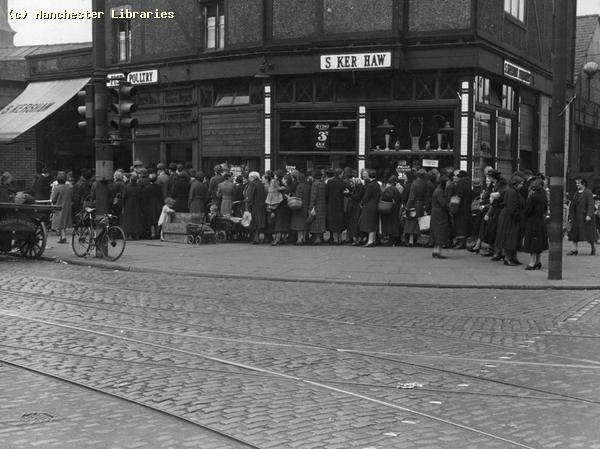
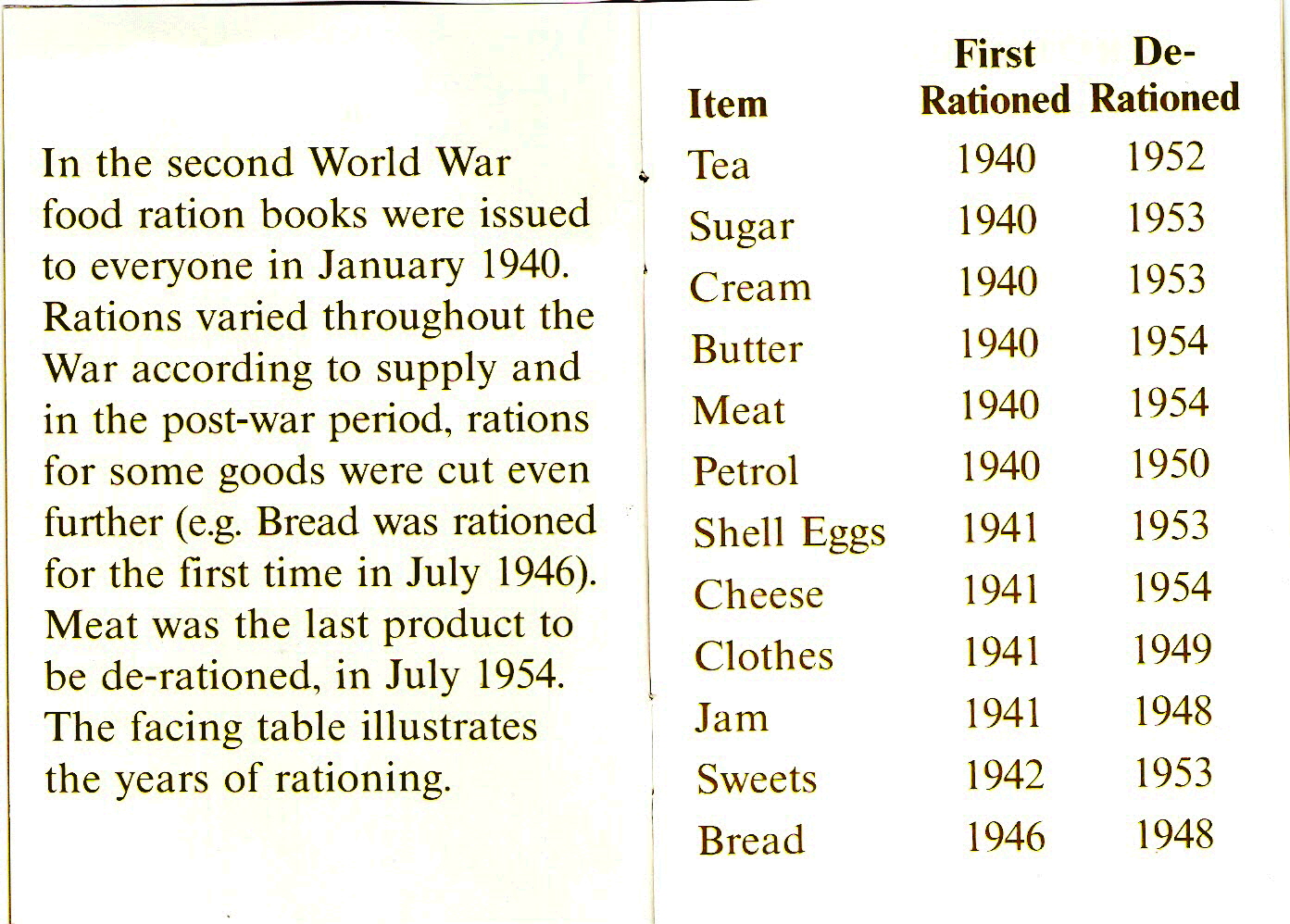
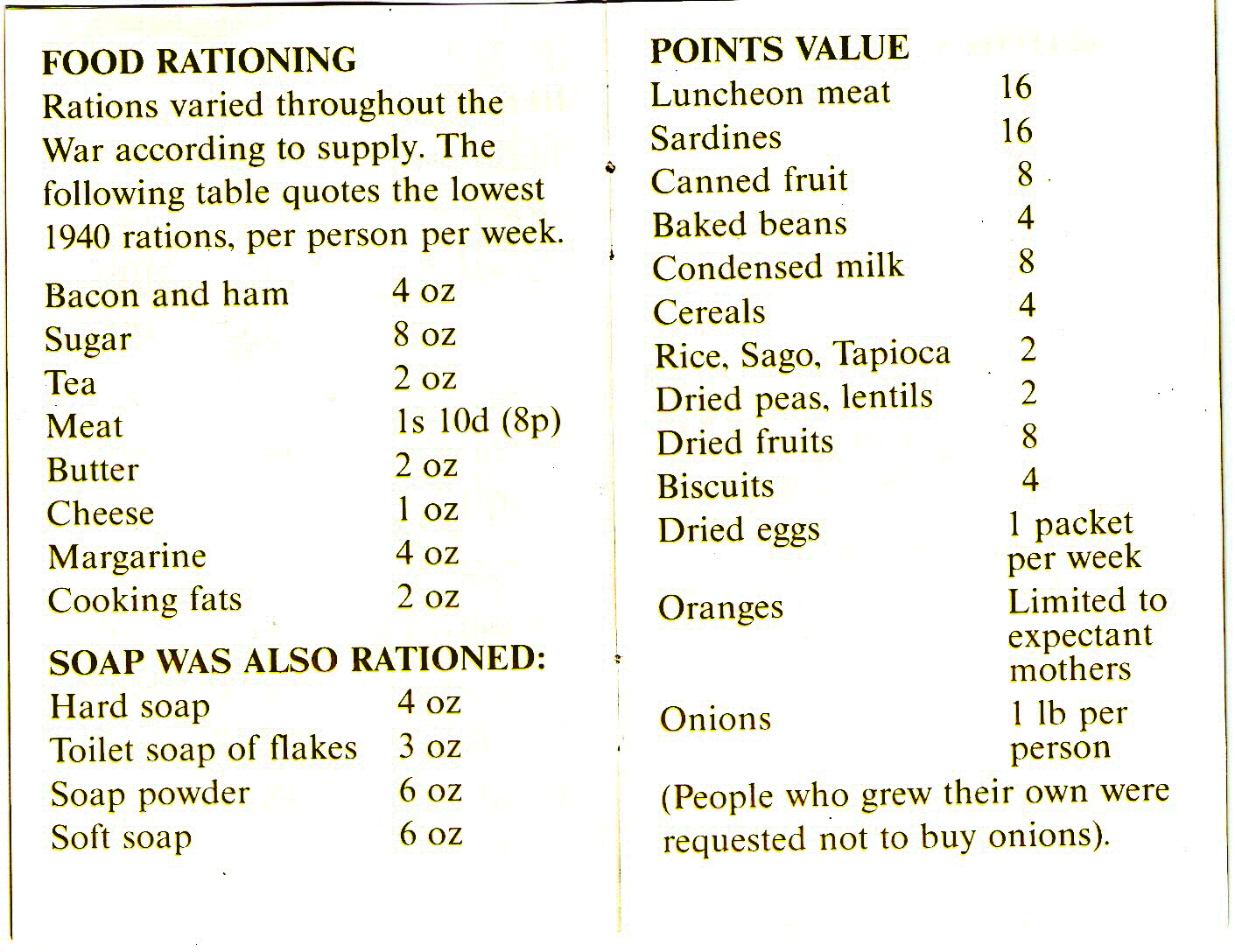
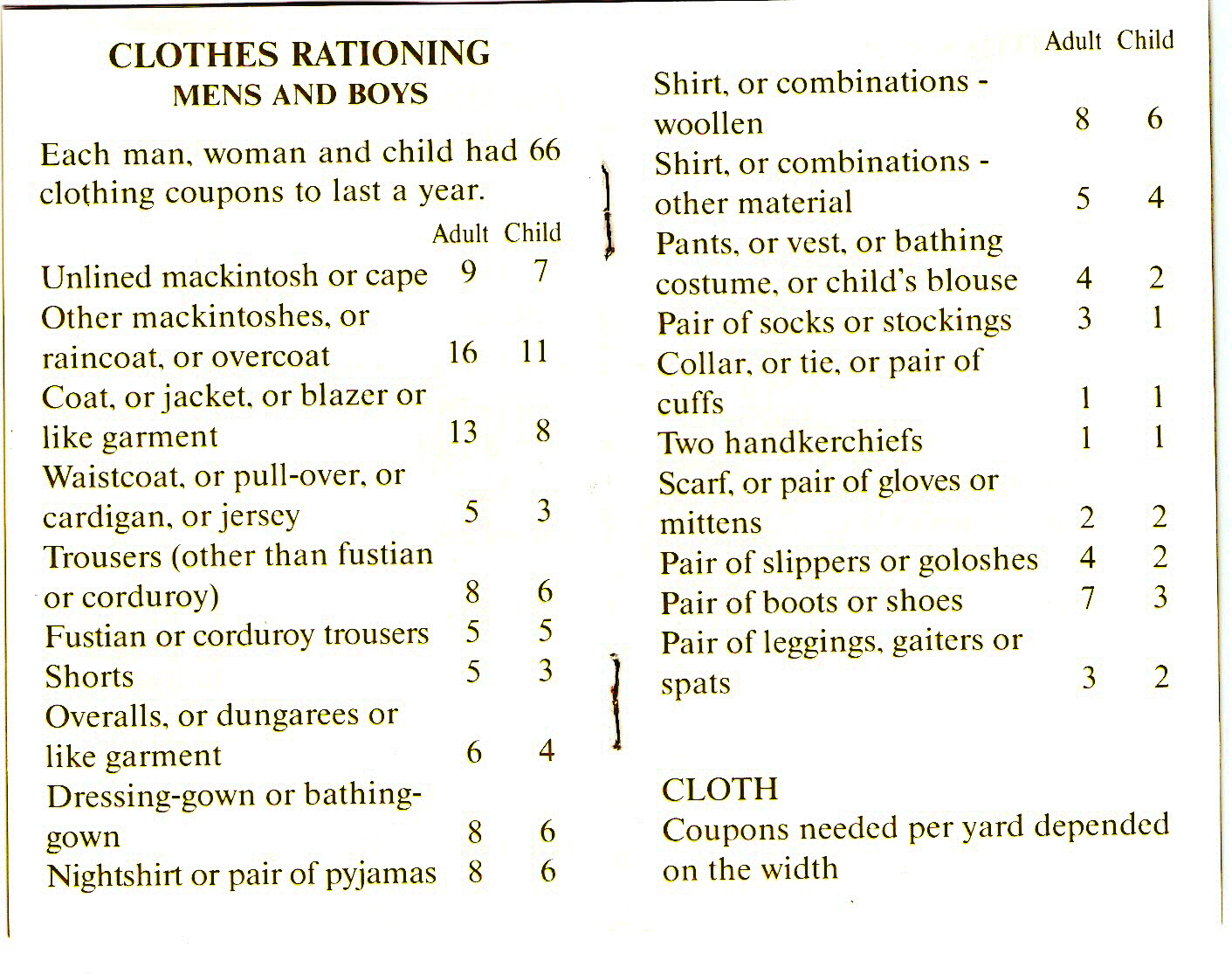
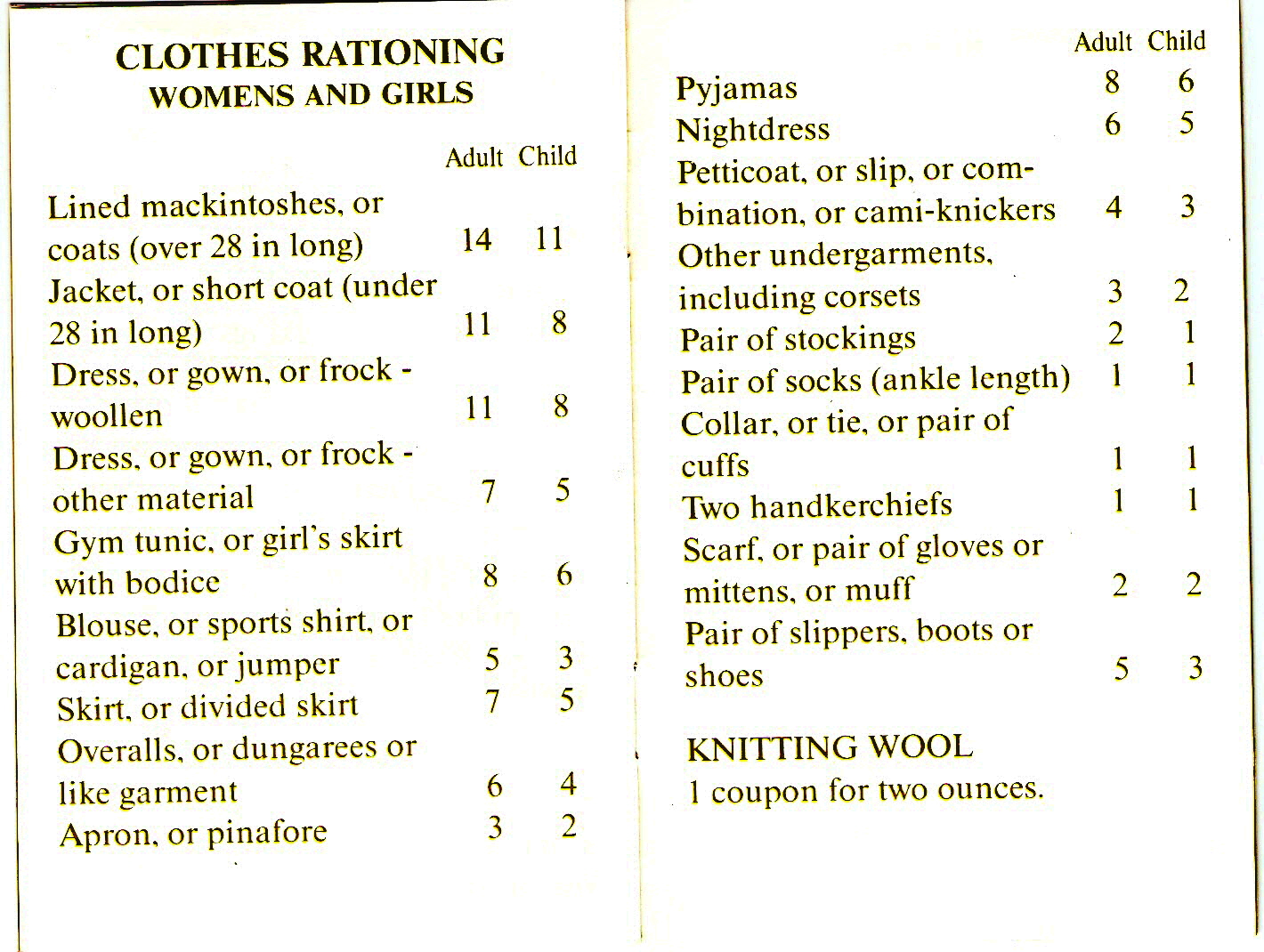
At the beginning of the war measures were implemented to ration food and eventually many other items. Families were issued with ration books, and certain items were made available on certain days. The above scene would have been witnessed all over Britain. As Britain was never self sufficient in certain commodities and foodstuffs some items were still rationed into the 1950s!!
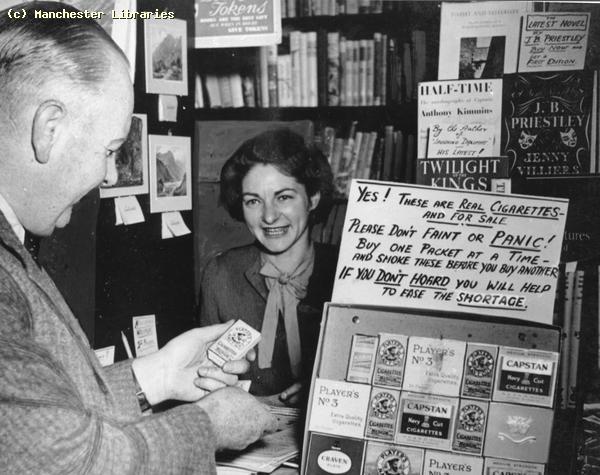
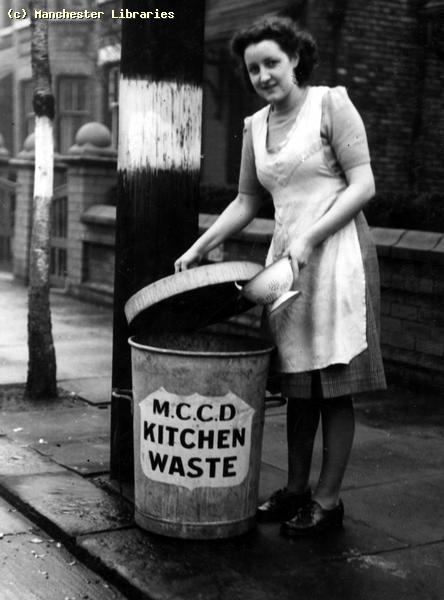
Two more rationing photos 1) cigarettes on sale in a book shop? 2) Saving kitchen waste. This would be used to feed animals, mainly pigs. Also note the white stripes painted on the trees. This was to aid walking and driving in the blackout. The blackout, which meant no visible lights during hours of darkness, lasted throughout the war years. ( Manchester Libraries) Rationing Information
|
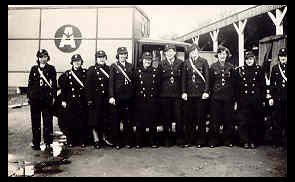
 The names shown on the back of this second photo are:-Miss L Bryant, Mrs
V.Holden, Miss M. Hope, Mrs C. Campden, Mrs E. Nicholson & Mrs F. Corns.
From memory Lilian Bryant was a friend of my Mums, and related to the
Bryants Furniture family.
The names shown on the back of this second photo are:-Miss L Bryant, Mrs
V.Holden, Miss M. Hope, Mrs C. Campden, Mrs E. Nicholson & Mrs F. Corns.
From memory Lilian Bryant was a friend of my Mums, and related to the
Bryants Furniture family.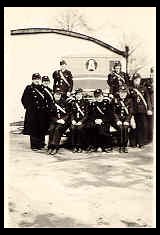
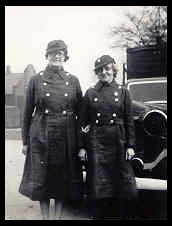
 The second photo here shows Miss Hope & Mrs Campden again. My Mum & Aunt
are standing on the running board of the ambulance in the first photo. I
have no idea who the gentleman is, but he looks a proper "Captain
Mainwaring" type!
The second photo here shows Miss Hope & Mrs Campden again. My Mum & Aunt
are standing on the running board of the ambulance in the first photo. I
have no idea who the gentleman is, but he looks a proper "Captain
Mainwaring" type!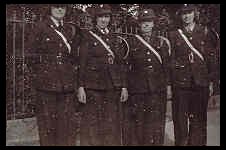 This final photo shows my Mum, Doris Wilson & aunt Mary Nixon, on the left
of the group. I still have my Mums ARP ( Air Raid Precaution) metal cap
badge!
This final photo shows my Mum, Doris Wilson & aunt Mary Nixon, on the left
of the group. I still have my Mums ARP ( Air Raid Precaution) metal cap
badge!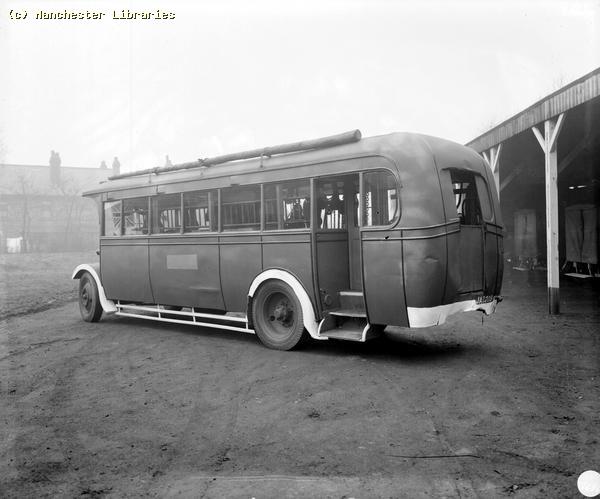
.jpg)
.jpg)
.jpg)